School notice:
To book a tour, please call 0121 838 9590 or email info@nppa.shirelandcat.net.
School notice:
To book a tour, please call 0121 838 9590 or email info@nppa.shirelandcat.net.

Early Years at Newfield Park Primary Academy


Early childhood is the foundation on which children build the rest of their lives. At Newfield, we greatly value the important role that the Early Years Foundation Stage (EYFS) plays in laying secure foundations for future learning and development. Throughout EYFS we plan to ensure our youngest children receive high quality learning experiences that build upon existing knowledge, understanding and skills. We aim to ensure children receive rich and stimulating learning opportunities that support learning and development. Our children learn best by feeling secure, valued and confident and also through quality play. Our unique approach to Early Years means we ensure that our children flourish and meet their full potential.
We recognise that physical development is fundamental to educational achievement and mental well-being. Strong core stability, gross motor strength, and fine motor control underpin successful handwriting and support wider learning across the curriculum.
Our exciting curriculum will provide a range of high-quality learning experiences through carefully planned and structured, play-based learning. This is complimented with focused adult-led teaching daily including phonics, storytime, maths, handwriting and topic-based lessons.
The three prime areas of learning are listed below:
These specific areas of learning are detailed below:
We recognise, support and value the contribution of parents to their child’s development. At Newfield, parents and practitioners work together and the results have a positive impact on children’s development and learning. Positive parental partnerships are crucial for providing the most effective teaching and learning strategies. Equally, they are vital for personalising learning opportunities effectively.
We aim to develop positive relationships with parents that enable us to share information about children’s interests and learning. This information is used to personalise learning opportunities and provide continuity and progression. We work together and support learning through warm and trusting relationships.
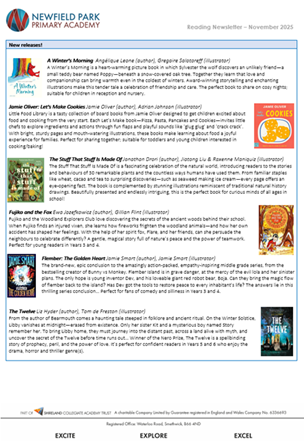
We run Maths, Phonics and Reading parent workshops, as well as focus days which allow you to see how learning takes place at school and helps to support you with learning at home. In addition, activities such as our Travelling Book Bag, Secret Reader, and our use of Class Dojo help you stay connected to your child’s education, as well as apps such as Collins E-Books which allow your child to do additional reading at home. To keep you informed, we regularly share our bespoke Reading Newsletters, Curriculum Newsletters, and the Newfield News, so you always know what your child is learning and experiencing at school.
“Before children can write independently, they need to be able to say (aloud or just to themselves) what they want to write. A wide spoken language gives them more that they can write about and more words for what they want to say. Their expressive and receptive language develops through talk and listening.” – Reading Framework (2023)
We believe that talking before writing is the key to unlocking attainment and accelerating progress for every child. Our curriculum prioritises strong foundations in language and communication, ensuring pupils are ready to access the wider curriculum from the earliest age.
We use Little Wandle Letters and Sounds Revised for high-quality phonics teaching and Little Wandle Foundations for Language to develop vocabulary and oracy skills right from the start of Early Years. Alongside this, strategies such as Colourful Semantics support sentence structure, handwriting, and fluency, giving children the tools they need to succeed.


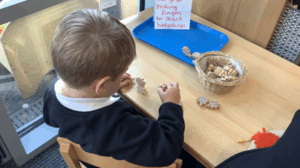
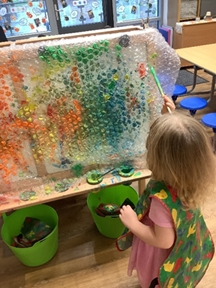
Handwriting is not just about forming letters—it begins with physical development. Through Kinetic Letters, we build gross motor strength (core stability, shoulder and arm strength) and fine motor control (finger dexterity and grip) so children have the stamina and precision needed for fluent writing. Activities include climbing, balancing, and resistance exercises to strengthen muscles, followed by targeted fine motor tasks like threading and squeezing to prepare hands for pencil control. This approach ensures children develop strong posture, correct pencil grip, and confidence in forming letters accurately.
Our communication-friendly spaces and daily oracy opportunities help children to build confidence in speaking, share ideas clearly, and articulate their learning. By embedding these approaches, we create a language-rich environment where pupils develop a love of words and become confident communicators.
Our teaching of Maths is highly practical and interactive, designed to inspire a love of mathematics from the earliest age. Children have many opportunities to build mathematical understanding through exploration, problem solving, discussion and hands-on experiences using manipulatives such as Numberblocks and Numicon.
We place a strong emphasis on developing a secure sense of number, which sets children on the path towards mathematical confidence in later life. In the Early Years Foundation Stage, mathematics is woven into play so that children develop understanding in meaningful contexts. Programmes such as Numberblocks are used to make number concepts engaging and accessible.

Our staff are trained through the Maths Hub and NCETM, ensuring that teaching reflects the latest research and best practice in early mathematics. This commitment to professional development means children benefit from approaches that build deep conceptual understanding.
We run parent workshops focused on early maths strategies, helping families understand how to support number sense and problem-solving at home. These sessions strengthen the home-school partnership and reinforce key concepts beyond the classroom.

“Listening to the teacher as she explained how Maths is taught was a revelation! What a great way to put over to the children all that is expected of them in Reception. The ‘5 and a bit’ model, the coat hanger number pairs and part and part-whole model were explained to us and my daughter knew exactly what to do and how to do each of them. I have to say I think back to my childhood and wish that I had had this way of learning early maths.” – Parent (Maths Workshop)
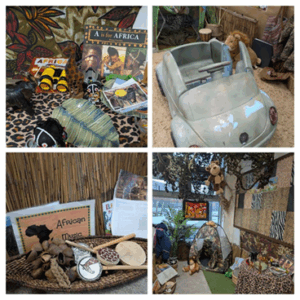
We promote the Characteristics of Effective Learning (Playing and Exploring, Active Learning, and Creative and Critical Thinking) as well as the prime and specific areas of learning. We do this by providing all children with a wide range of rich, meaningful first-hand experiences through inspiring themes such as Space, Superheroes, Out of Africa, and Dragons and Castles.
Children in EYFS enjoy both indoor and outdoor “direct” learning experiences. We encourage independence by enabling them to access materials freely, take pride in their work, make sensible choices, and maintain high expectations of themselves and others.
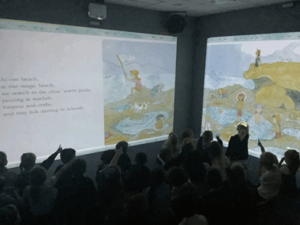
To enhance learning, we use our interactive Portal to immerse children in 360° experiences they could not otherwise access – for example, a spectacular visit to the surface of the Moon or a safari trip to the African Savannah – all linked to curriculum areas.
We aim to develop children’s artistic and cultural awareness while nurturing imagination and creativity. Regular opportunities to engage with the arts allow children to explore and experiment with a wide range of media and materials. These include African drumming and Dance workshops run by a local secondary school.

Through topic work and stories, children gain a deeper understanding of the world around them. They are encouraged to ask questions, investigate how things work, and begin developing early Geography and History skills. These experiences help them understand their place in the community and appreciate the roles of others.
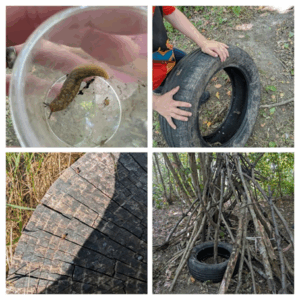
We enrich our curriculum with experiences that build cultural capital and broaden children’s understanding of the world. Forest School sessions promote physical development, resilience, and a love of nature. In addition, community visits – such as meeting firefighters, exploring a farm, or learning about the role of the police – help children understand important careers and their place in the local community.
In Early Years, technology is used to enhance experiences rather than replace them. Pupils explore a wide range of technologies across different activities, experimenting with how they work and what they enable them to do. Examples include BeeBots that introduce early coding concepts, our interactive smartboards and tablet devices with age-appropriate programmes. Children also have the opportunity to visit and use The Portal, immersing themselves in 360° experiences that bring learning to life – such as a visit to a farmyard or an underwater journey beneath the ocean.
Our Nursery offers a carefully planned, teacher-led provision for both 15-hour and 30-hour places, ensuring every child receives high-quality early learning experiences. Play-based learning is at the heart of our approach, with adult-led sessions designed to consolidate key concepts and build strong foundations.
Our Nursery curriculum also includes opportunities to explore the wider world, ask questions, and begin developing early Geography and History skills, helping children understand their place in the community.

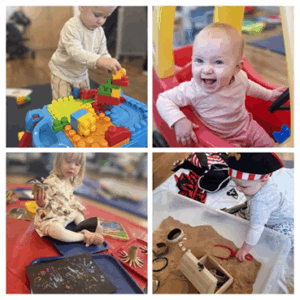
Our Stay and Play sessions are a thriving part of our Early Years offer, held every Wednesday morning to strengthen home-school partnerships and support children from birth to four. These teacher-led sessions are carefully planned with seasonal themes and special focus activities, giving families practical ideas to develop language, early maths, and physical skills. Parents receive supportive materials and advice for home learning, ensuring continuity between school and home. Activities include soft play, sensory experiences, and opportunities for shared learning. We work closely with IEYS teams to provide stimulating experiences and guidance, helping families understand our approach to early education and preparing children for a smooth transition into Nursery and Reception.
Maths typical-progression-comparison
Maths typical-progression-cardinality-and-counting
Maths typical-progression-shape-and-space
Maths typical-progression-composition
Maths number blocks episode sseries 1 to 5
Maths typical-progression-pattern