School notice:
To book a tour for Reception 2027 entry, please call 0121 838 9590 or email info@nppa.shirelandcat.net.
School notice:
To book a tour for Reception 2027 entry, please call 0121 838 9590 or email info@nppa.shirelandcat.net.



At Newfield Park Primary Academy, we believe that language and English is fundamental to the development of children and their access to the curriculum. We recognise that the acquisition of English, both spoken and written, will empower our pupils and provide the foundation for all their future learning.
We promote a culture of reading, not simply as a life skill, but to also develop in pupils a love of books and literature that will not only support their learning across the curriculum, but also enrich their lives. We believe that the understanding and intelligent use of English is the cornerstone of a child’s education; we strive to engage pupils through an ever increasing amount of ‘reading for pleasure’ initiatives, working with parents to ensure children are reading high-quality texts on a daily basis. Our range of Reading for Pleasure initiatives can be found on our Reading for Pleasure offer found here. As children move through the school, they will improve their comprehension ability through direct teaching of VIPERS which are linked to the KS1 and KS2 content domains, via both guided reading and our Read Aloud Think Aloud shared reading approach. These are built into lessons weekly and increase in difficulty as children move through the school. For more information on the planning of reading, click here to see one of our Reading Unit Plans.
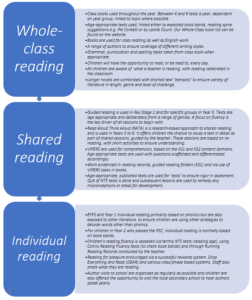
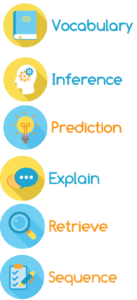
Reading comprehension can be improved by teaching pupils specific strategies that they can apply both to monitor and overcome barriers to comprehension. We have identified some core Reading Skills that pupils need to be successful readers. Each skill is represented by the acronym ‘VIPERS’ (see below) to ensure whole school consistency and to engage pupils in the comprehension activities.
Reading for Pleasure is at the heart of school life, celebrated through a vibrant and varied offer. Children enjoy regular ‘Drop Everything and Read’ sessions, collect reading certificates, and participate in author visits, Secret Reader events, and World Book Day celebrations. Our reading corners and libraries are inviting spaces filled with high-quality, up-to-date books, magazines, and comics, while initiatives like the Book Wish Box, Reading Ambassadors, and Superhero Readers (parent volunteers) ensure every child feels inspired and supported. We also foster community links through Halesowen Library visits, immersive experiences in The Portal, and our monthly Reading Newsletter. The school’s commitment is further strengthened by engagement with the latest research and partnerships, ensuring our approach is always evolving to ignite a lifelong love of reading in every pupil. For more information on Reading for Pleasure click here.
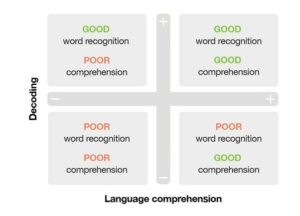
At Newfield, we believe that high quality, discreet systematic synthetic phonics lessons are essential to the development of early reading and spelling. We base our phonics lessons on the Little Wandle Phonics programme but have adapted it to suit our needs at Newfield. This learning starts early in a child’s time at Newfield, with use of Little Wandle Foundations for Phonics beginning in Nursery. We assess the children’s phonic knowledge regularly (using our rigorous Phonics Tracker program) and this assessment is used to identify children who need a ‘catch up’ intervention. Home and guided reading books for Reception and Year One children will be phonic-based texts, based upon the child’s phonic ability. Children will not access book banded books until Year Two. Children who have not passed the Phonics Screening Check in Year 2 will also take home phonics banded books to ensure they are continuing to improve on their phonics understanding.
Statutory requirements for the teaching and learning of English are laid out in the National Curriculum in England: English Programmes of Study – Key Stages 1 and 2 and in the Communication and Language and Literacy sections of the Statutory Framework for the Early Years Foundation Stage. Our curriculum is drawn from these documents but is bespoke to Newfield Park Primary Academy.
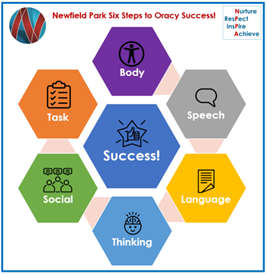
We believe that all children should have regular opportunities for speaking and listening and our bespoke “Six Strands” help us to achieve this in a simple, child-friendly way which builds progressively from Early Years to Year 6. Children will have various ways of learning and utilising these crucial life-skills, whether in Class Assemblies, our Newfield ParkCast weekly live sessions or in whole-class performances such as Newfield’s Got Talent.

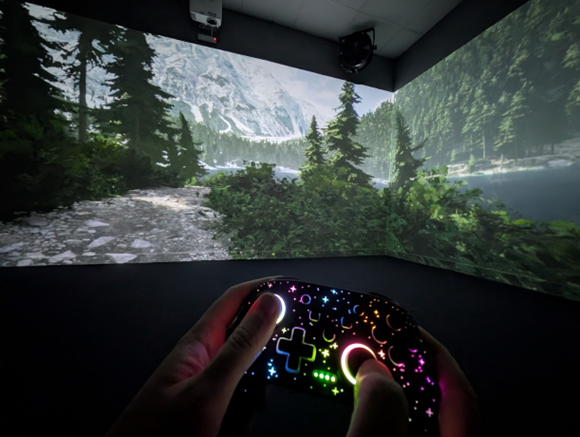
We want every child to feel fully immersed in their writing journey, crafting brilliant pieces that have a clear audience and purpose. We provide authentic, real-life reasons to write and make use of visual literacy tools such as our interactive 360 degree Portal (which you can see in the photo) to spark imagination and creativity.
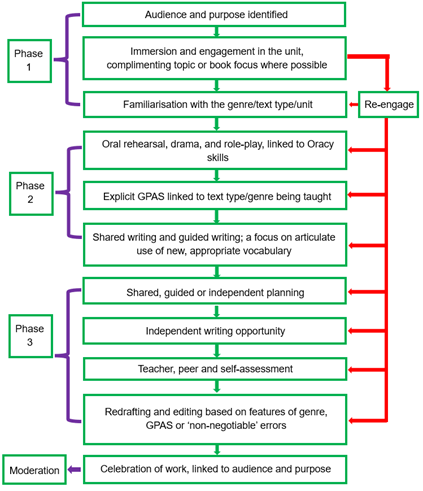
Pupils experience a wide range of purposeful genres before leaving primary school, ensuring breadth and depth in their writing. We believe writing is a craft that grows through purposeful practice and clear progression, so our English Teaching Sequence guides children from rich text immersion and discussion to oral rehearsal, shared writing, and finally independent ‘destination writing’ for a real audience. Teachers first begin by using the Long-Term Planning Grid to determine their Writing Unit Plans – ensuring objectives are mapped and covered across the year. An example of a Writing Unit Plan can be found here.
Each lesson begins with our BRICK Sentence approach, giving pupils daily opportunities to overlearn grammar and sentence structures through short, focused tasks, building confidence to manipulate language effectively. Across the year, teachers plan six to eight high-quality units, each culminating in a published piece that matters—whether it’s a letter, a speech, or a story—so children see why writing is important and feel proud of their achievements.
To see the full version of our English Teaching Sequence, please click here. We aim to provide children with a range of real-life purposes to write for, making use of visual literacy (including our interactive Portal) when possible and ensure that children experience a range of purposeful genres before they leave Primary Education.
We aim for our children to leave in Year 6 with their own style of fast, fluent and legible handwriting. We use the Kinetic Letters handwriting programme to achieve this. Kinetic Letters makes handwriting a valuable tool rather than a hindrance, benefitting every curriculum area, self-esteem, and engagement with learning.
We have high expectations that what is taught and practiced in handwriting sessions will be applied in other subjects each day. Handwriting is a taught skill that develops at different rates for different children. All staff in school have high expectations for handwriting across the curriculum and believe that a flexible, fluent and legible handwriting style empowers children to write with confidence and creativity.
Handwriting will be emphasised, especially in published pieces, where pupils set out to display their own personal standard. This ensures that pupils develop fluent, legible handwriting and take pride in the presentation of their work, reinforcing the high standards we expect across all aspects of English.
Kinetic Letters has four threads: